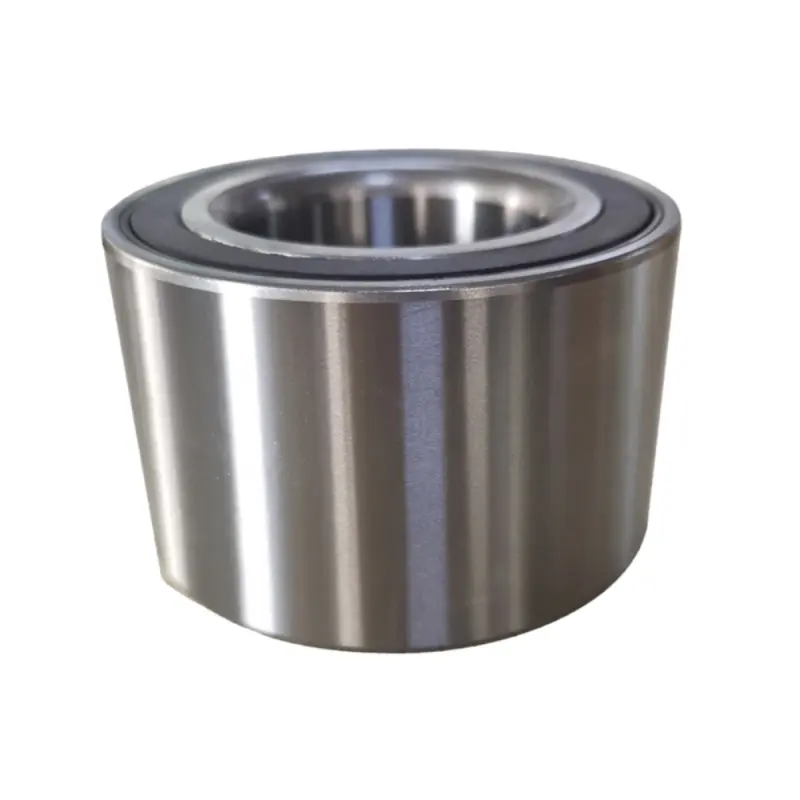
European distributors have a real reason to be cautious about Chinese hub bearings. Enough bad product has reached the market that "it went quiet for four months and then started humming" is a familiar story. It is worth being precise about what actually goes wrong, because all three causes are visible in the bill of materials.
1. Forging steel
A hub bearing race is forged, then heat treated, then ground. If the steel has inconsistent cleanliness, inclusions become crack initiation sites under repeated shock load, and the race spalls. This does not show up on a test bench in week one. It shows up in month six.
Our partner forges from Xingcheng Special Steel (GB/T699-2015 55# forging steel) — the same mill that supplies SKF, FAG and NSK. That is a checkable fact, and it is the single most useful question to ask any supplier: name the steel mill.
2. Ball grade
Ball grade governs how evenly load is distributed across the race. Loose-tolerance balls concentrate load and brinell the raceway. Our partner uses G10-grade balls from Tsubaki Nakajima, Japan.
3. Grease
Hub bearing grease has to survive high temperature next to the brake disc and stay in place behind the seal for the life of the unit. Cheap lithium grease breaks down and migrates. Our partner uses KYODO YUSHI AF-1, Japan.
The three questions worth asking
- Which mill supplies your forging steel, and can you show the material certificate?
- What grade are the balls, and who makes them?
- What grease, and what is its temperature rating?
A supplier who cannot answer these three quickly is buying finished bearings on the open market and relabelling them. A supplier who can answer them is telling you where the cost went.
For completeness: our manufacturing partner has been building bearings since 1958, holds IATF 16949:2018, ISO 45001:2018, ISO 14001:2015, and runs 100% ABS sensor testing on every unit before packing.