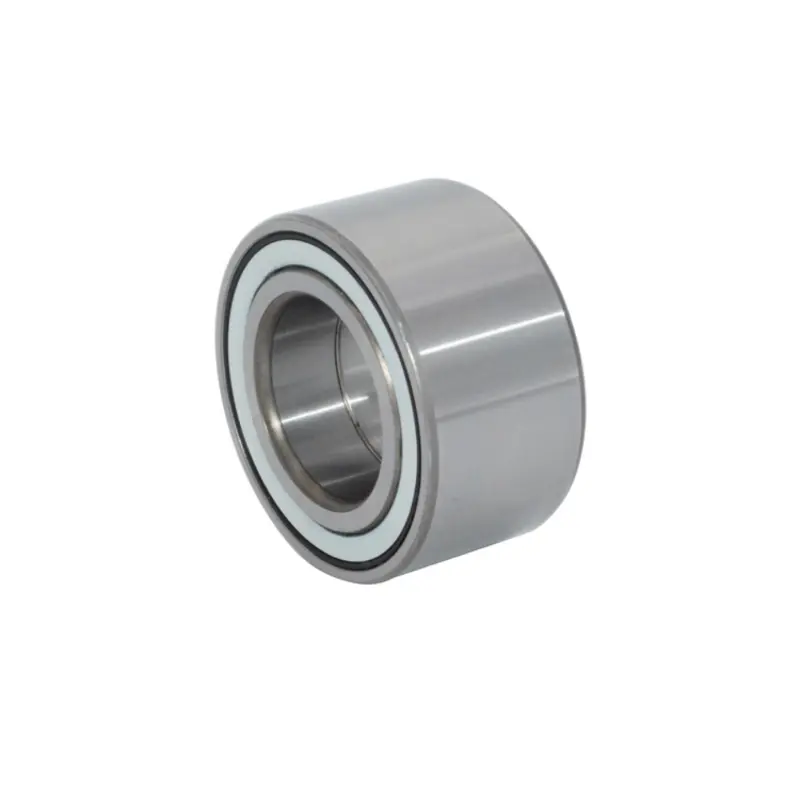
Catalogues list wheel bearings by generation, but the generation is really a statement about how much assembly work has been moved from the workshop to the factory.
Generation 1
A sealed double-row ball bearing with no flange. It presses into the hub carrier and carries the hub separately. Common on older European platforms and on many rear axles. Cheapest to ship, but requires a press to fit.
Generation 2
The bearing carries an integrated flange for the wheel mounting. Fewer parts to press, faster fitting, and the preload is set at our partner's assembly line rather than in the workshop. Most European front axles built after roughly 2005 use this design.
Generation 3
A complete hub unit: bearing, wheel flange and inner flange in one bolt-on assembly, usually with an integrated ABS magnetic encoder ring. Bolts straight to the strut. No press work at all, which is why workshops prefer it and why encoder quality decides whether the ABS light comes on.
Why it matters commercially
The three generations do not compete with each other — they fit different platforms. But they behave very differently as stock:
- Generation 1 is small, light and cheap to ship, and tends to move slowly across a wide range of references.
- Generation 2 and 3 are heavier and take more space, but carry higher value per unit and turn faster because they cover the volume European platforms.
- Generation 3 units with an integrated encoder ring are the ones where quality complaints concentrate, because a failed encoder produces an ABS fault that the customer notices immediately.
If you are building a first order, the practical approach is to take the Generation 2 and 3 references that cover your highest-volume platforms and test those before broadening the range.